
Notes from a January visit to Sebastiano Ricci of Tenuta degli Ultimi
Sebstiano Ricci loves dogs. Walking through the pedestrian heart of Treviso, he stops to pet random dogs belonging to strangers. He seems to read their energy well. Clearly, Sebastiano is enamoured. At home in Conegliano, three big boxer-mastiff style beasts are like his children. There must be a lot of slobber in the household. I’m surprised Sebastiano can tolerate it. He’s a meticulous guy. His clothes are all tailored. He recognizes my winter coat as being from Palto, a brand manufactured nearby, in Friuli. On the way to dinner, he apologizes for the mess inside his Mercedes SUV. By my standards, the vehicle is immaculate.
Sebastiano picked me up at the piazzale Roma: the Venice bus station. We were traveling to a remote Michelin-starred restaurant on a lake for dinner. But first, a stop in Treviso, for taglieri. The night was young: why not stretch out the culinary adventures? Ricci knows all the spots. We waded through the post-work bustle and past the largest mortadella you ever did see into the relative warmth of Dai Naneti. It’s the old man bar of your dreams, if you dream in vivid salumi colors and blissful olfactory overload. An abundance of BTG options (Ribolla, Tai, Manzoni, Verdiso, Verdicchio, Timorasso, Raboso, among others) are advertised behind the meat counter, all available for less than four euros a glass. Why would a wine drinker ever leave? We ate large amounts of perfect testa, culatello, and Monte Veronese cheese with our bicchieri. It felt like an immovable object of culture, the old world still thriving.
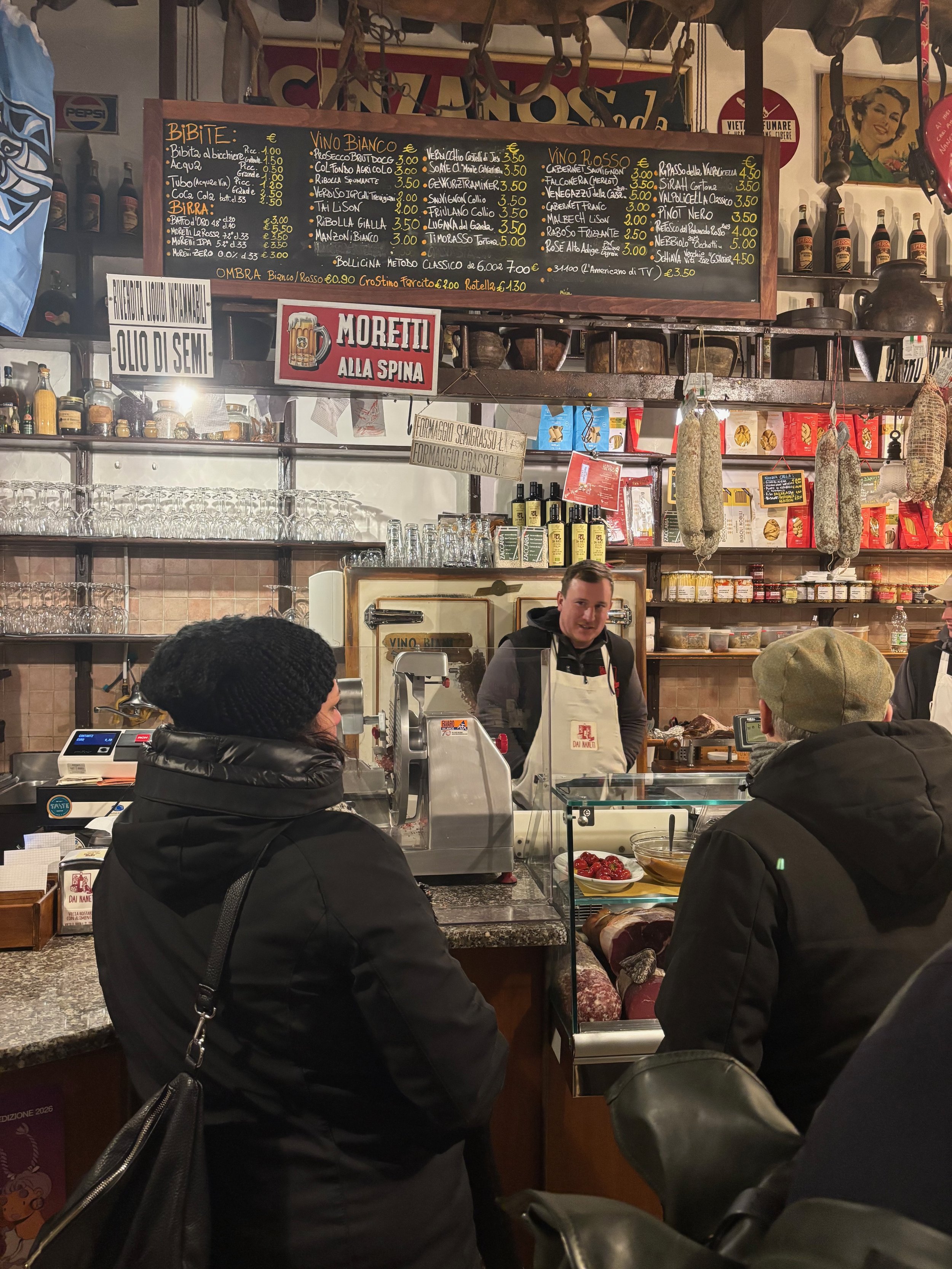
Butchers and bartenders know to keep an eye on strangers who look like trouble.
In spite of this affordable opulence, Sebastiano reported that the cost of everything in Italy is rising. Energy, wine closures, labels. Ricci also mentioned that he moved back to Conegliano from New York City because a simple plate of pasta alla Sorrentina in Manhattan cost $30. Too much for a normal meal. The Italian lifestyle he enjoys was untenable in that metropolis. According to Sebastiano, Italy has something very precious that needs to be protected. The issue is, how can the country sustain its gift to the world, in the face of global competition. The precise culinary traditions that we enjoyed at Dai Naneti (and elsewhere over the course of the evening) are the result of generations of craft, attention to detail, and fervent belief in the importance of high quality. Cheap facsimiles proliferate. The rising popularity of the simulacra, ubiquity of knock-offs globally, it’s a travesty, and a threat.
Sebastiano has no children. He worries about the future of what he is building. Where should he focus the time he has left on earth? Who will continue the work? In Ricci’s case, I think fretting is unnecessary. The man is 43. Not ancient. Also, he’s the 11th of 11 children. Surely a niece or nephew will wade into the fray when Sebastiano is ready to retire. It’s more likely that wrapped up in the DNA of the detail-oriented, driven personality of a human like Ricci is a tendency to be overly concerned about everything, including one’s legacy.
While driving into the wilderness, we talked about other Italys that Ricci loves. He was born near Como, and holds that land close to his heart. Sebastiano is surprised we don’t import anything from Oltrepo Pavese, a DOCG of Lombardy of continually emerging potential and quality. It’s likely a blind spot of mine. Also a gap in the wine knowledge of most Americans, I reckon. His driver-side monologue really catches fire at the mention of Pantelleria. Sebastiano loves the island, a speck in the Mediterranean closer to Tunisia than mainland Italy. He talked at length about an ancient iconic farmer who grows Zibibbo grapes. Ricci became obsessed with the man’s work, going as far as working the harvest with him during a season. I neglected to write down this heroic vigneron’s name. With only 7,000 inhabitants, I’m pretty sure I could find him if I made a short trip to Pantelleria. Which I probably won’t. Giorgio Armanni had a house there. Ricci said there was barely enough of this man’s unicorn wine to distribute to the Italian peninsula, much less North Carolina. Some things are better left undisturbed where they grow.
I’ll admit, at least for me, Sebastiano Ricci remains a man shrouded in mystery. In spite of many visits, I don’t have the full picture. And that’s fine. Every winery isn’t an open book. For example, this year I gleaned that Ricci bottles only 10% of the fruit he grows. It’s why his wines are unerringly high quality, even in tough vintages like 2025. The best Glera grapes stay with Tenuta degli Ultimi. Also, Ricci utilises very old vineyards, a bulwark of quality winemaking everywhere. He’s committed to slowly improving the estate’s organic farming, to keep these old vines alive, and to adapt with climate change.
2025 was an even tougher year for red wines, which were the topic of conversation during our dinner at Locanda San Lorenzo. It’s a restaurant famous for lamb: perfect for Tenuta degli Ultimi Merlot. Sebastiano has ten vintages of the wine in cellar, bottled but not yet labeled. It’s a passion project. He’s waiting for the right moment to release them. Locanda San Lorenzo served lamb eight ways, including tripe and brains, both of which were excellent. I was fully on board for an octet of lamb at the beginning of the meal. Of course there were also multiple desserts, paccheri, squash risotto, snails (obviously) seafood, barley, onions, bread and butter. The works. I started to stumble after five or six lamb morsels. Somehow I think we avoided grappa. I think.
Maurizio Donadi of Casa Belfi makes Tenuta degli Ultimi’s very natural red wine. He’s part of a trio of oenologists employed by Ricci. The wine is unfined and unfiltered. Nothing added. Three thousand bottles made. Some vintages are aged in amphora. These tasted more complex and (perplexingly) more Bordeaux-like. The non-amphora versions hewed closer to a pure black fruit profile. They matched the blackness I felt pushing in on the bright clean modern dining room from surrounding mountain and forest.
As interesting and enjoyable with dinner as the reds were, I showed up for the sparkling wine. The new Prosecco labels provide visual reference to a place in the vineyards near Collalto that Sebastiano likes to visit for moments of quiet contemplation. He designed the previous labels with his brother. And we liked them! They were fun. But the new ones are better.
The current Sanguefreddo Prosecco Superiore extra dry DOCG has 12 grams per liter of residual sugar. It rests at the intersection of brut and extra dry, and could be labeled as either. Which is apt. The wine is seamless. Pure ripe orchard fruit, no real discernable sweetness. It’s a wine that presents the best face of a misunderstood grape variety. Sanguefreddo is gentle, also complete.
In need of something a little lighter? Ciacola has six grams per liter of residual sugar. It’s a wine for convivial moments. Apertivo hour. There’s some melon and a citrus edge. Very well-made. This must be one of the best price-to-quality ratios in our warehouse.
Sebastiano likes to release older Proseccos. We intended to drink a 2013 Biancariva single-vineyard “riva” Prosecco at dinner. Time flies, conversation carried us along and oops! We left it unopened at Locanda San Lorenzo. Ah well. I hope the eerily similar-looking wait staff (think Twin Peaks, or The Shining) enjoyed it post-work. They moved noiselessly through the room, taking unobtrusiveness to its spectral outer limit. Inadvertently, Sebastiano returned the bottle to a pre-alpine terroir that created it. A restaurant on the edge of a lake, in a spot favored by rock climbers, quite close to his ancestral hometown. A gift for the spirits, perhaps.
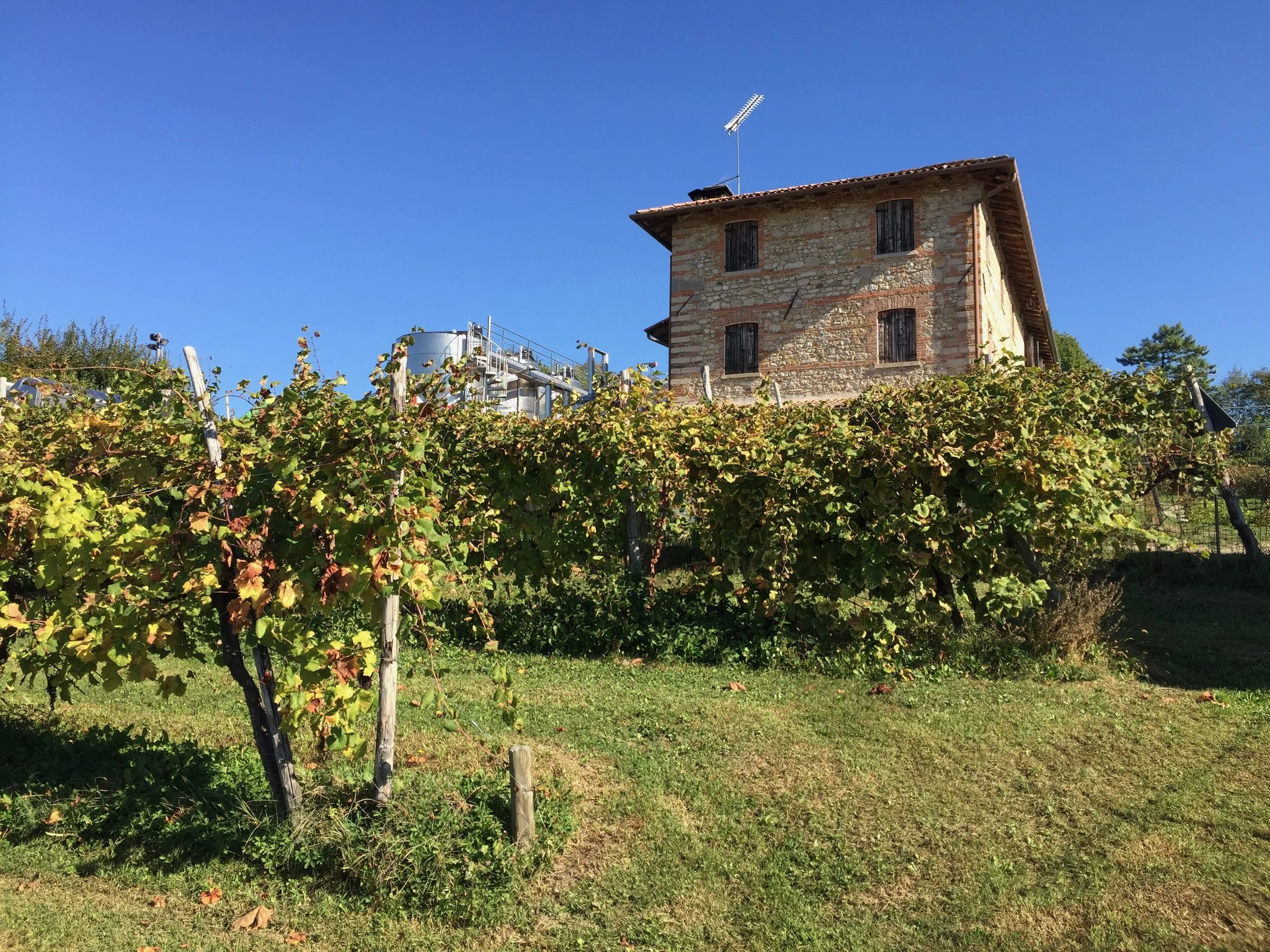
Sunnier days at the Ciacola vineyard