
Pizzo Coca/ A visit to Valtellina
I met Lorenzo Mazzucconi on a vineyard road. Some locals were walking their dogs along the path. A panorama of mountains enveloped the trail. Roads this narrow make me nervous. Or more precisely, winding paths with no guard rails and steep vertical drops and two way traffic make me nervous. I found a wide spot, to park the too-large rental car. We met in the Grumello vineyard. Sassella was in front of us. Valtellina isn’t terribly big, or difficult to figure out. It’s an east-west slope hugging the Swiss border. You can see much of the zone from a few elevated vantage points.
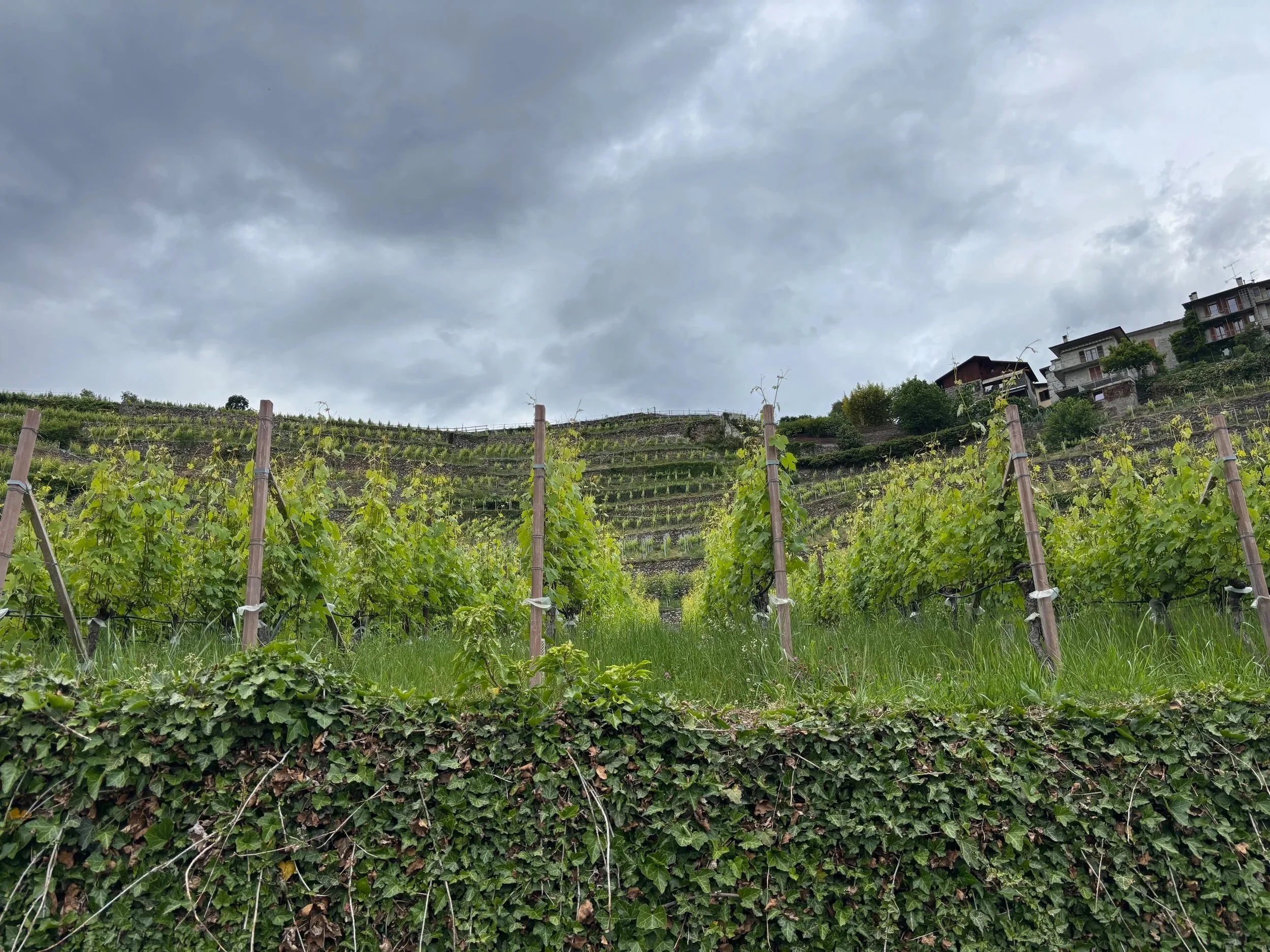
vines near the Grumello cru
Bedrock changes fast in the area. Valtellina is on the edge of a tectonic plate. Jagged mountains rise around it. The Retici mountain chain reaches 4,000m in elevation. Facing them across a broad valley are the Gerola mountains, a cheese lovers paradise whose peaks reach 3,000 meters above sea level. Every summer Lorenzo hosts a party called Tracimati at 2,000m above sea level in that mountain range, among the cows. I wound through that landscape one day before meeting Lorenzo, on a thwarted quest for Bitto and Casera cheese made in the hamlet of Gerola Alta. A bored barista informed me I was too early in the season. It was late May. Empty half timbered buildings and a bubbling Alpine stream made up for the lack of available fromage. The cheese shop was closed. Randomly. A paper note on the front door delivered the bad news.
Back in Grumello, Lorenzo shared some back story. Along with partner Alessandro Aldisquarcina, Mazzucconi planted his first vineyard in 2012. He’d studied winemaking in his native Bergamo. Since 1982, his father and uncle had been commercial honey producers. Lorenzo was in a beekeeping club, and wanted to follow in their footsteps. But his uncle told him essentially to “get a real job,” that there was no future in beekeeping. Oenology school was the compromise they reached. After graduation, Lorenzo worked for three years at Dirupi, a dynamic estate that I view as at the vanguard of the new generation in Valtellina. He also worked in New Zealand and Piemonte. Perspective is important.
In 2016, Lorenzo and Alessandro started Pizzo Coca “in a serious way.” Putting together a new estate in the area isn’t easy. The vineyards are fragmented. Mazzucconi showed me a 1,700 square meter parcel that he farms. The land was previously owned by four different families. In 2012 the site was in bad shape, as was the old man who had worked it before. The farming had been chemical intensive. Lorenzo and Alessandro had to start from the ground up, adding posts, which is no easy task in the granitic bedrock of Grumello. They started farming the land in an organic way. Recovery is a slow process.
At the time of my visit, Lorenzo was preparing to remove some leaves from his vines. Chiavennasca is vigorous. Cutting the upper part of the plant to slow growth and lower productivity is necessary. In early summer they mostly do vine work, and later in the season simply cut the grass. The parcel where we met mainly had 60-year-old vines, but there was a diverse range of vine ages in the terraces.
The Orobie mountain range stops much of the rainfall that would otherwise reach Valtellina. Pizzo Coca is the name of the highest peak in the Bergamo Alps. The last few years have been wet in the area. Most vintages average 800mm of rainfall. Because of the exposition of the area, its vines benefit from a high amount of radiant sunlight over the course of a typical viticultural year.
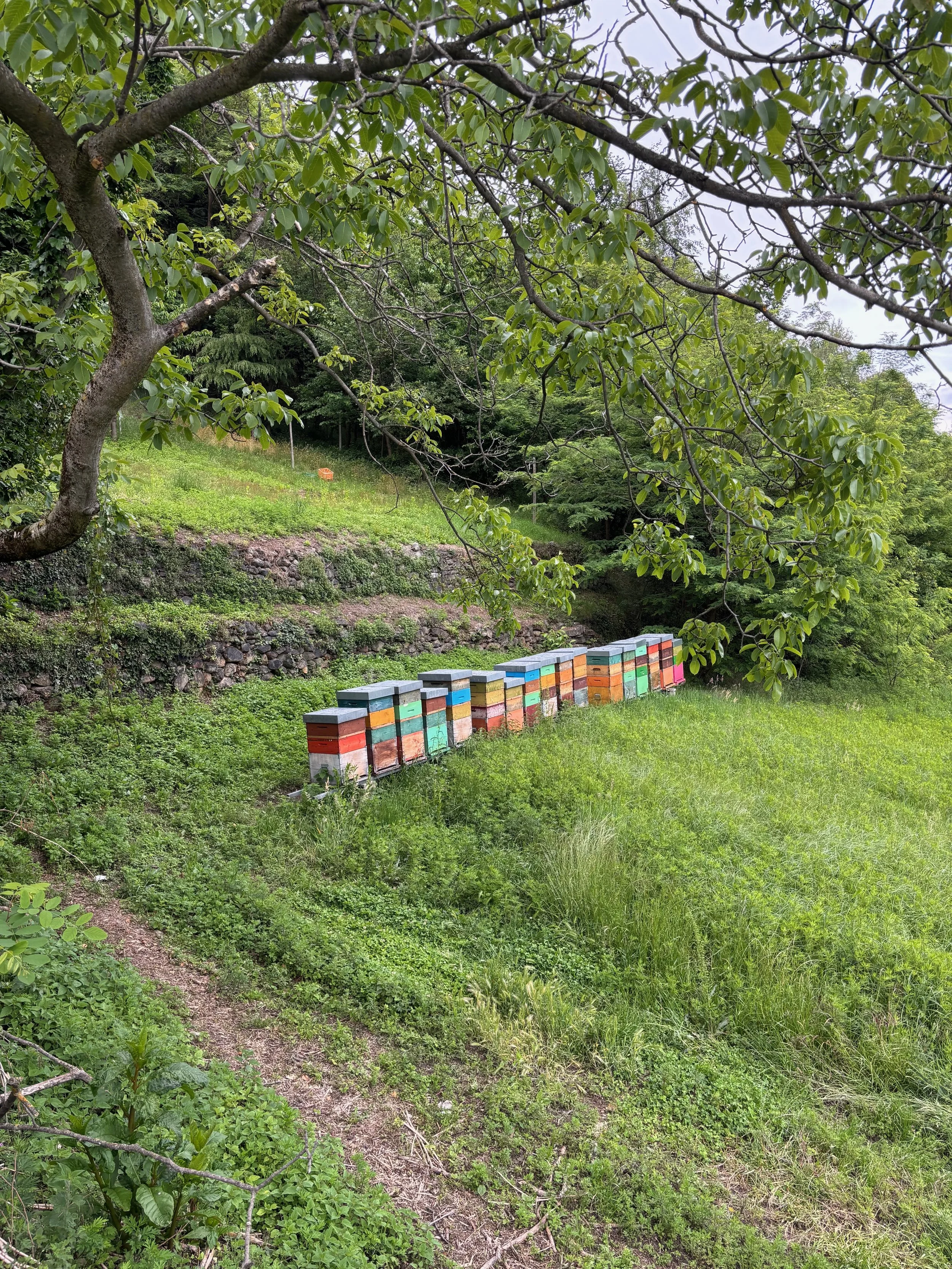
Pizzo Coca have many beehives
After some careful mountain goat traversing of dirt paths between vine blocks, we piled into Lorenzo’s car for a trip to the Inferno vineyard area. This is the only named “cru” of Valtellina that Pizzo Coca bottle. The grapes from first area we visited were destined for a Rosso di Valtellina/Valtellina Superiore bottling. Lorenzo’s Inferno vines are around the San Fidele church, in the vicinity of Poggiridenti. The soil is mostly schist. Two of these parcels are declassified to use in their IGT Rosso, a main reason why that wine is dynamite. The main parcel of Inferno that Pizzo Coca farm is in the eastern part of the Inferno cru. In general the vines of this area are 450-600 meters above sea level.
Lorenzo and Alessandro’s cellar is in Ponte. It’s a town of 2,300 inhabitants, and 19 churches. As well as being on a tectonic plate, Valtellina is a site of schismatic activity, historically a border land which two branches of christianity were eager to claim as their own. The shepherd-to-flock ratio was noteworthy. As we inspected an adjacent Valtellina Superiore site, Alessandro’s children waved down to us from the window of an apartment high above the farmland. “They are spies,” Lorenzo joked. “They see if I am working.” Most of the vines of the parcel are thirty years old. The last owner had a bad way of pruning, which caused a lot of plants to die, so new plantings are scattered throughout the rows. Lorenzo chooses not to use a traditional tractor in the field, because there’s a decent amount of sand in it, and he wants to keep air in the soil. The vineyard is planted with the first clone of Chiavennasca, which was developed in the 1980s. The plants make really big bunches, and eventually high alcohol: muscular wines with a lot of tannin. Each village in Valtellina had its own biotype of Chiavennasca, many dating back to the phylloxera era. There are at least 40 iterations of the grape.
As mentioned earlier, a decade ago Lorenzo and Alessandro started their farming work in earnest. From the beginning they planted all available clones/biotypes of Chiavennasca. They started working in biodynamic agriculture, in collaboration with Marco Ferrari and another local grape grower. In the winery they follow the biodynamic calendar, and also use Steiner’s schedule to determine when to prune. Copper and sulfur are the only vineyard treatments they employ.
We moved to a third vineyard: a half hectare of terraces. The fruit grown at the site lands in their Rosso di Valtellina. Along with Chiavennasca, there’s some Pignolo in the vineyard. Lorenzo noted that the biotypes selected for the field reflected the thinking of a farmer from a century ago. The grapes have big bunches, and more pulp than skin. It’s a seventy year old vineyard which was hand grafted onto American rootstock in the field. Today there are plastic collars around the vines. Lorenzo doesn’t love plastic, but the contraptions stop worms from eating the vine shoots, which can be a disaster in Nebbiolo-growing regions, as Nebbiolo doesn’t produce second shoots. Without the collars, a farmer can lose 50% or more of their crop.
The vines we look at are trellised in a system similar to Guyot, but with old wood kept on the bottom root. Walking around the field, the biodiversity is remarkable. Below looming, imposing snow-capped peaks, but native flora abounds. Cactus emerged from black mica walls. Lorenzo said the former farmer was a man named Rino. The bottling from the field bears his name. Rino had a great knowledge of local grasses. He also had a strong affinity for chemical fertilizer! Today Pizzo Coca makes 3,000 bottles from the land. Rino made 7,000.
It was time for a cellar tour. The world of wine is small. Years back, I’d met Lorenzo at FIVI, a wine fair in Bologna. We’d been introduced by William from Clivo Altura, himself a young winemaker, and an early visitor to Lorenzo’s winery/cellar in Ponte! I’m glad William made the introduction that led me to Pizzo Coca’s front door. The place is impressive. Stone, cold, dark, a former dairy with numerous twists and turns and staircases and small rooms. Ponte is a medieval town, a place once rich from cattle farming. On the day of my visit it felt spooky. Narrow stone streets, imposing ancient buildings. Lorenzo said that some noble families in the town had vast subterranean spaces beneath their houses, up to 200 square meters under dwellings. The latteria’s cellar space feels vast.
In the cellar, Lorenzo and Alessandro destem everything. They only use friends and family for harvest, to control quality. If the grapes aren’t perfect, they start fermentations pied a cuve. Pristine fruit is fermented with spontaneous native yeast. Fermentation is in steel, with regular pump overs to prevent reduction. Twenty percent of the wine is made in concrete and vertical tonneaux. Lorenzo has his own bottling machine (always a plus) and bottles in April after the harvest.
We tasted the 2025 Rino Valtellina Superiore from barrel. It was a difficult vintage, marked by a rainy spring. Very fresh floral raspberry aromas are in the foreground of this wine. Lorenzo noted that he ended up with good quality and quantity of the wine, but the work to achieve this endpoint was difficult. They had three days of rain (150mm) at the harvest, which started around the 20th of September. Sugar levels in the grapes were low, but ripeness of the seeds was good. The wine is currently resting in Hungarian barrels. I thought it was really good. Normally, Rino is picked the first 10 days of October, so 2025 was an early harvest. In spite of 25 days on the skins, it’s a wine with low levels of extraction. On the palate there’s a lot of chalky tart cherry, which I found quite delicious. Lorenzo noted that there are no lees in the barrels.
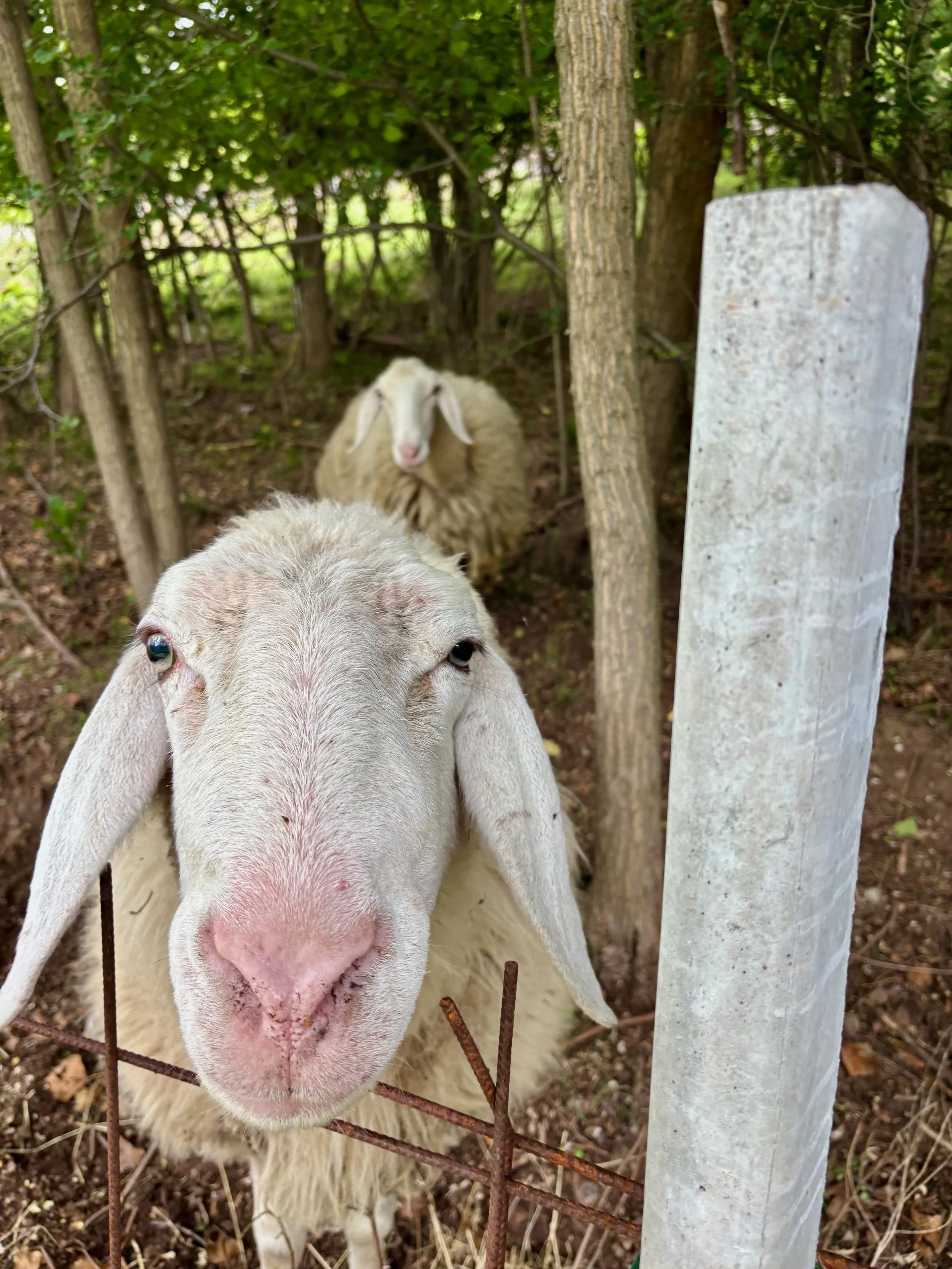
some residents of the farm
The 2025 Infernot bottling (tasted from barrel) had a more overt kirsch aroma. This wine will get a full year of additional wood aging, because it is substantially more intense than the other reds at Pizzo Coca. Spicy, brambly, almost stemmy. Dark in color, with some soil aromas. Also candied fruit and baking spice.
Tasted from bottle, the 2025 Rosso di Valtellina (IGT Retici Alpi) was wildly fruity. Spicy raspberry. Delicate, floral, charming. Strawberry. It’s a lighter vintage, and I like it. Twelve percent alcohol by volume. Lorenzo uses an old vertical press for his reds. This machinery may be difficult to utilize, but the gentleness of the crush surely benefits this style of wine.
The 2022 Rino Valtellina Superiore is from a hot, dry vintage. Blue/black fruit aromas. It was picked last, on the 8th of October. They waited longer to collect this parcel, to find the perfect ripeness of the pips. By Valtellina standards this is a big red, with substantial tannin and alcohol. A mountain red for lovers of Barolo etc. In spite of the substance, there’s elegance here. Dark cherry, round mouthfeel. Savory characteristics.
There’s so much to like. They raise chickens and sheep. Predictably, dozens of beehives are strewn around the estate. The honey they sell is sublime. Lorenzo even grows acacia trees for wood to heat their buildings. It’s a small farm in all the best ways. The kind of place that two ambitious people should start, and that we should support.
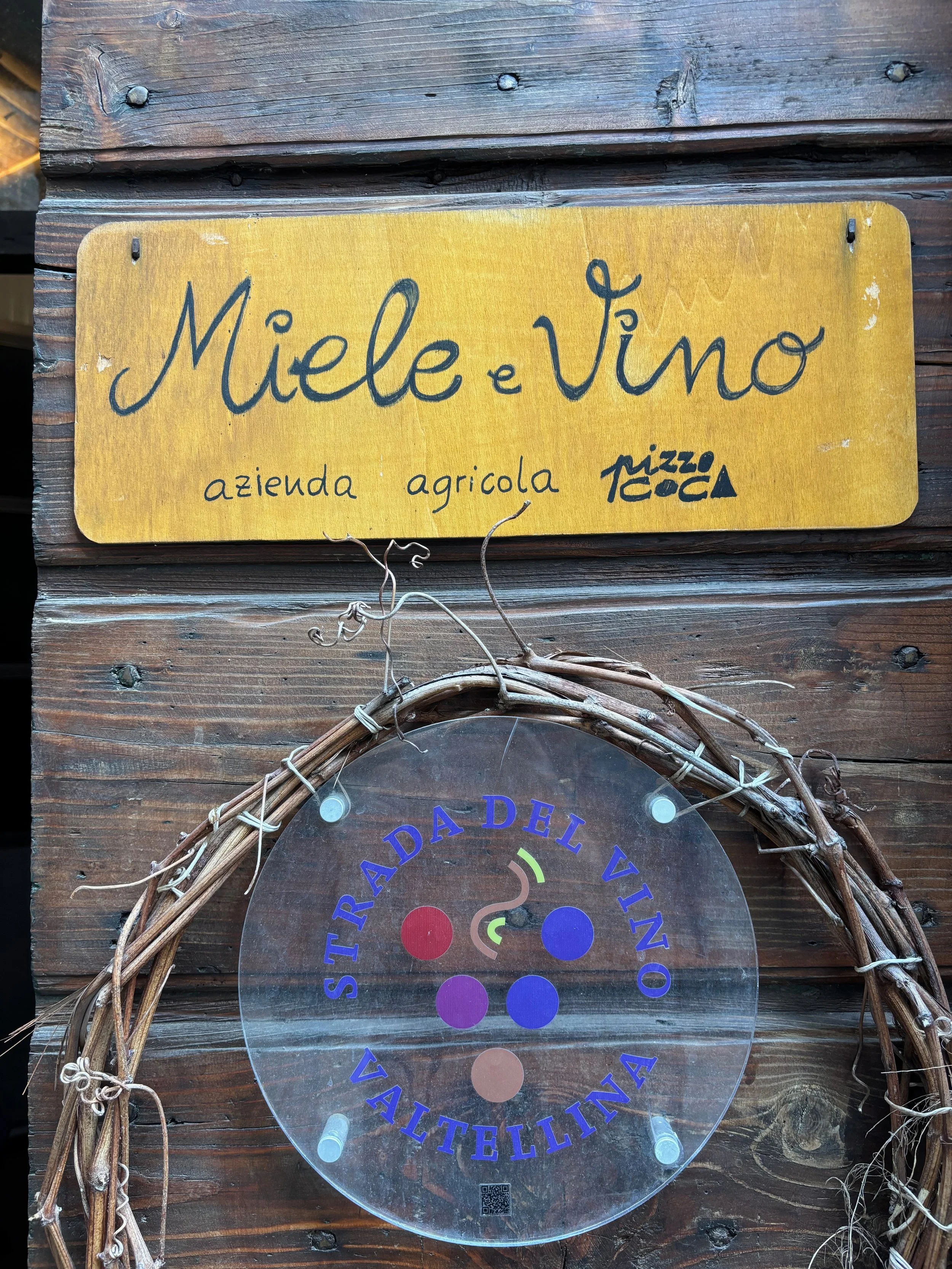
At the cellar door in Ponte.