
Steepness, Wildness, and Sand: A visit to Occhetti
Stefano Occhetti’s father and grandfather were born in Frazione Occhetti. His father built the house Stefano and his winery inhabit. The site had been a vineyard. His father was more of a builder than a farmer. In fact, the driveway to Stefano’s home is something of a construction site. I arrived uncertain of where to park, how to be out of the way. Tools from previous work were scattered around the place. Stefano insisted the real work was done. The cellar has been expanded. He built several of the walls himself. Some plaster needs to be applied, othersise they are finished.
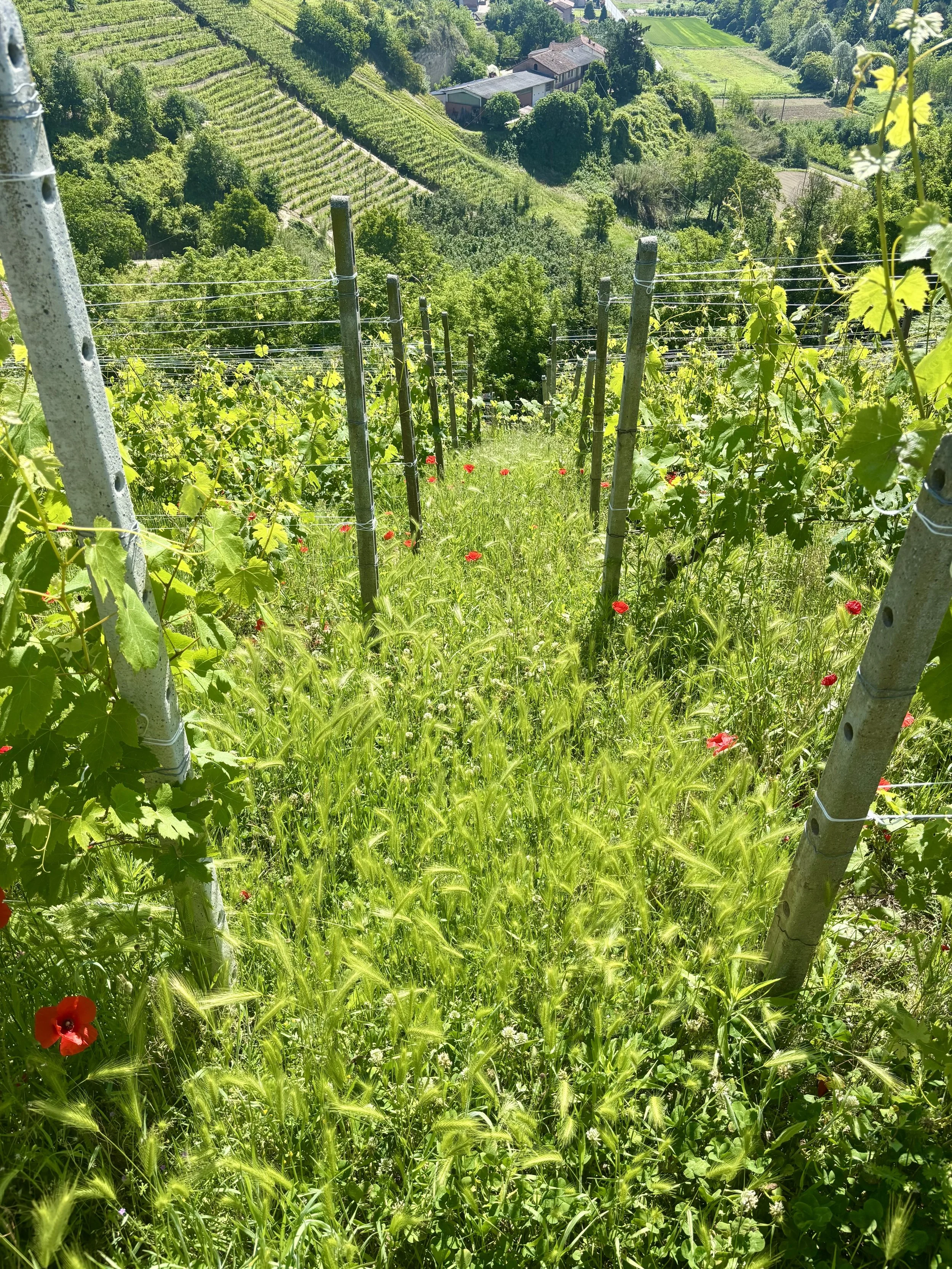
More lawn care than I’d like to tackle
We survey the village from the top of his drive. Sanché and Valmaggiore are parallel hills. The Occhetti cru starts from the village church, a stone’s throw from Stefano’s house. The zone is steeper than Montá, home of Giovanni Almondo, the other Roero farm in our portfolio. The distance between the properties is short. The fields Stefano Almondo and his brother work are just over the other side of the hill from frazione Occhetti.
The Occhetti cru used to be famous. Legendary winemaker Beppe Colla made an Occhetti bottling when he was working at Prunotto, circa 1976. Historically important and large winery Ratti made some Occhetti bottlings in the same era, using purchased fruit. Today Stefano Occhetti has vines in the area Prunotto farmed a half century ago. Today Prunotto is owned by Antinori. They still make a Langhe Nebbiolo that claims Occhetti as point of origin.
Seminal Italian wine critic Luigi Veronelli wrote positively about the Occhetti cru, and its parallel Valmaggiore. Bruno Giacosa and Sandrone made Valmaggiore somewhat famous. The Marchesi di Barolo is making a “huge” new vineyard nearby, three hectares in Sanché.
We wandered around. There are kids bikes and a trampoline. An asphalt futsal court. The old part of Stefano’s house was built in 1902. His parents live there now. Evergreen ornamental trees surround the old building.
The territory used to be hunting lands of aristocrats. Stefano moved back to his home village because he wanted space for his children. He wanted them to have a childhood similar to his, which was impossible in an urban area. Nature and farming and society comingle in this space. Monte Roero is a small village, at most 1,000 inhabitants. Looking around from the vantage point of Stefano’s driveway, the Occhetti vineyard area is quite small, and is dotted with lots of houses. A challenge in building recognition for the area will be the very finite number of bottles that can be produced.
We climbed into his 20-year-old Mitsubishi pickup truck and headed for the fields. The truck was covered in mud. Stefano tried to spray clean the windshield, to little effect. He said the season so far had been particularly rainy. We parked on a ridgeline. Across a small amphitheater of vines Stefano’s father was working the one vertical vineyard in the semicircle with a tractor. It was terrifying to watch. The tractor made a little leap each time it crested the field. Stefano noted that it’s turning before reentering a row that the dangerous part, as a tractor can tip over at that point. He refuses to do this work, but his father feels capable of doing the challenging driving.
All the grasses in the vineyards with horizontal rows must be cut by hand. It’s a massive amount of work. It takes him three weeks to cut the four hectares of grass that he has to tackle by hand. Stefano daydreams about a point in the future where this drudgery can be done by robots. It isn’t inconceivable. Already he uses drones to spray the steep fields. Because of the wet springtime, he’d already sprayed five times. Stefano is an organic farmer, but he isn’t anti-technology.
He points out that every small plot in the patchwork Southwest-to-east facing hillside is a different age of vineyard. Around the semicircle there exists a large amount of clonal biodiversity.
We walked through a large parcel of Sanché vineyard that Stefano farms. The vines were planted in 1950. Poppies bloomed between the rows. Soon he’d tie up the vines. In mid-May, there were signs the plants were about to flower. The rows were cleaned up, ready for the next phase. Stefano noted that in the southwestern part of his vineyards, vines were already flowering, one week ahead of where we stood. The Black Label wine that he makes comes from those early rows.
“Three elements make this place: steepness, wildness, and sand.” He emphasized that sandy soil really imparts the mark of Roero. All his vines are growing in sandy soil. On the southwestern side, two small plots of Arneis are growing. Stefano has Barbera in an east-facing lower vineyard, below his Nebbiolo.
May is a crazy amount of work for a Roero farmer. Cutting grass, tying up vines, planting, bottling. Occhetti also just purchased two new vats and a pump, to fill out his expanded cellar. The farm is still relatively new. He said it wasn't easy at the beginning. “Five hectares is enough!” Getting to a sustainable size took real effort. One hectare is still rented by Occhetti, but it’s a 30-year lease, almost the same as owning it.
“Manual work everywhere is the same.” He pointed that it was the arrival of the tractor that led to the abandonment of steep areas like the fields we surveyed. Suddenly, farming flat land with a large machine became easier. By the time Occhetti returned to his homeland, people were starting to abandon the fields. Old people were tired of working the steep fields. He had to clean out parcels that were essentially returning to forest, with only the posts signaling their previous utility as vineyards.
Year by year, he bought more small plots. Nobody else was interested. Now Stefano has one employee, Angelo. Also, Angelo’s wife helps on the farm six months of the year. We parked by an abandoned apricot orchard. It hasn’t been cultivated since 2014. Stefano will turn it into a vineyard soon. Cool air flowed out of the forest where we were parked. He said the site will ripen 20 days slower than other fields in the zone. Looking around us, it’s easy to spot abandoned cherry trees, also plums. Nature encroaches. The day was clear. Monviso was visible on the horizon.
One harrowing high-speed ride back down the hillside, and next thing you know we’re ensconced in Occetti’s cellar, tasting new wines. His house’s basement “where we used to party” is now the cellar.
2024 Langhe Nebbiolo is macerated for 10 days. It has very fresh, open cherry aromas. Clarity, fruit, fine tannin at the end. Stefano makes this wine in concrete. It is bottled unfiltered.
2024 Sanché was macerated for 12 days on the skins. It has a more immediate black cherry profile. Kirsch, depth, slightly more coarse tannins. Pronounced soil notes. Sanché is aged in small wood barrels for 15 months, and bottled unfiltered.
2023 Occhetti Rieserva is vinified in concrete. It has nice bruised strawberry aromas. Again, such clarity of flavor. Remarkable precision. “In September it will be very good I think,” he noted. There’s a whiff of balsamic. “My goal is to reach a medium level of structure.” The vines for the riserva grow in soil that is 45% limestone, give adds structure, and a similar amount of sand. “The riserva is more elegant, the Sanché more powerful, then Langhe Nebbiolo more casual.”
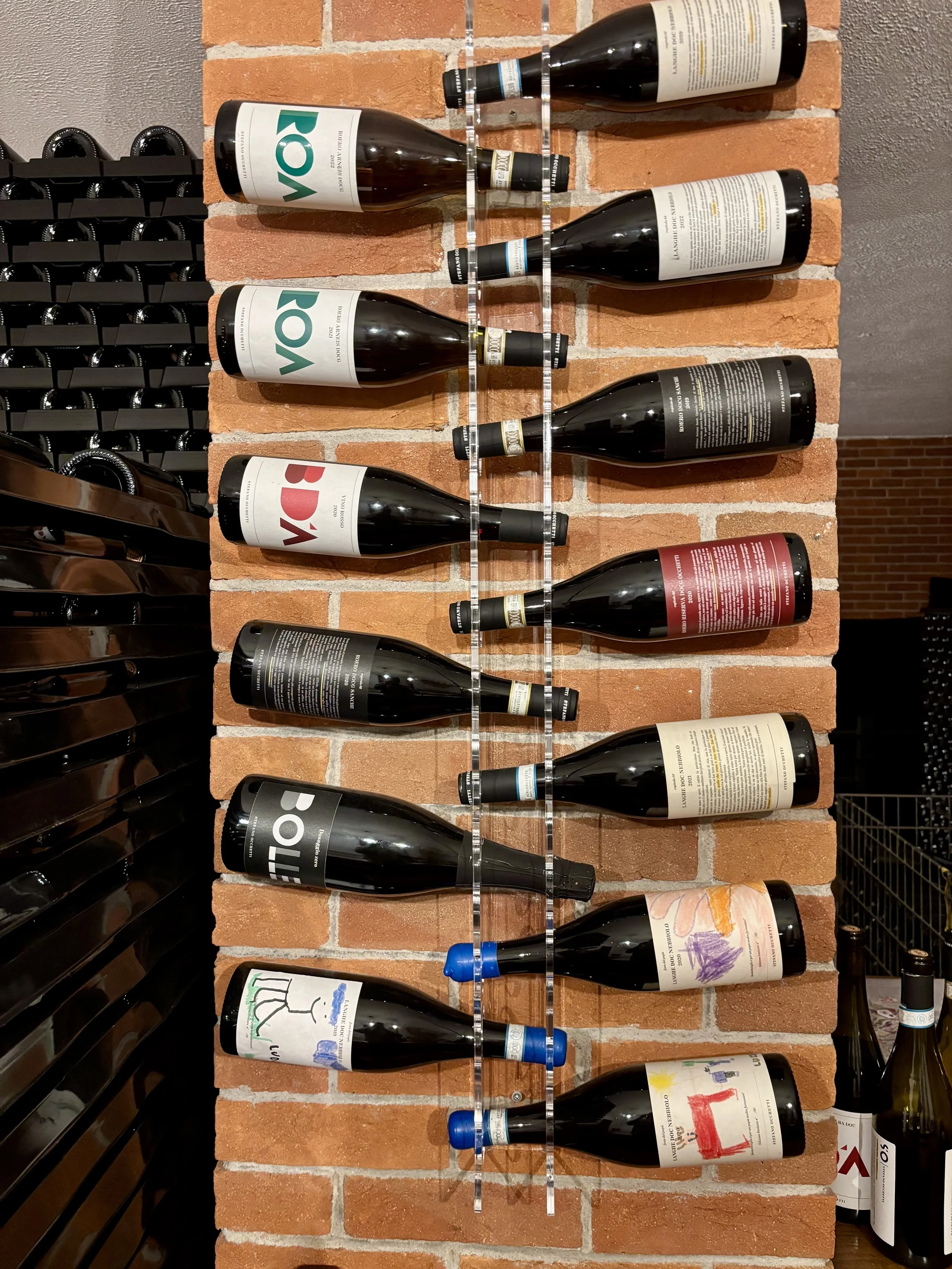
Artist labels
Stefano tries to follow the natural ripening stages of the vineyard parcels as they develop around his ampitheathre. He believes there are 12-14 different stages around the semicircle.
After a bite of cheese and salami, we walked into the work zone to taste wines from tank. The 2025 Langhe Nebbiolo will be bottled at the end of May. It is darker in color, and has more intense aromatics than the 2024. Cherry, some alluring plum darkness. It is closer in style to classic Langhe Nebbiolo. There’s a touch of green herb aroma, and rose. The wine is low in sulphites. Stefano will add a bit more at bottling, which will make the wine brighter. Fifty five mg/l total SO2.
2025 Barbera was bottled a month ago. It has real clarity, a theme at Occhetti. Graphite aromas. Light berry fruit on the palate. I’d say it still needs time to evolve. Some carbonic grapiness is evident.
2025 Arneis has a terrific honey apple aroma. Stefano allows three days of skin contact. The wine spent four months in wood barrel. Nice acid, green apple flavors, a sense of minerality. Stefano moved this wine back-and-forth into stainless steel tank to cool it off during fermentation. The process also increased oxygenation, as reduction has been an issue in his Arneis in the past. The early years of this wine were “too orange.” He wanted a macerated wine, but not too much in the orange wine style.
We departed Occhetti for lunch at the lovely Belvedere roadside restaurant in Roero. Empty, tranquil, a mother-and-son serving fried wild stinging nettles, seasonal asparagus, and other treats. I picked up a bottle of Roagna Barbaresco Paje from their extensive subterranean cellar to take home. Nothing else could really follow the line up we tasted pre-meal. I hope you got to meet Stefano when he visited NC in 2025 and early 2026. He’s a passionate guy, working so hard to elevate his home village to the appropriate level of recognition for it’s singular wines. We’ll get a new shipment of the wines profiled above this autumn. Stefano promised to ship them before the harvest, when the real work begins. If you are in the neighborhood, he throws a legendary harvest party!
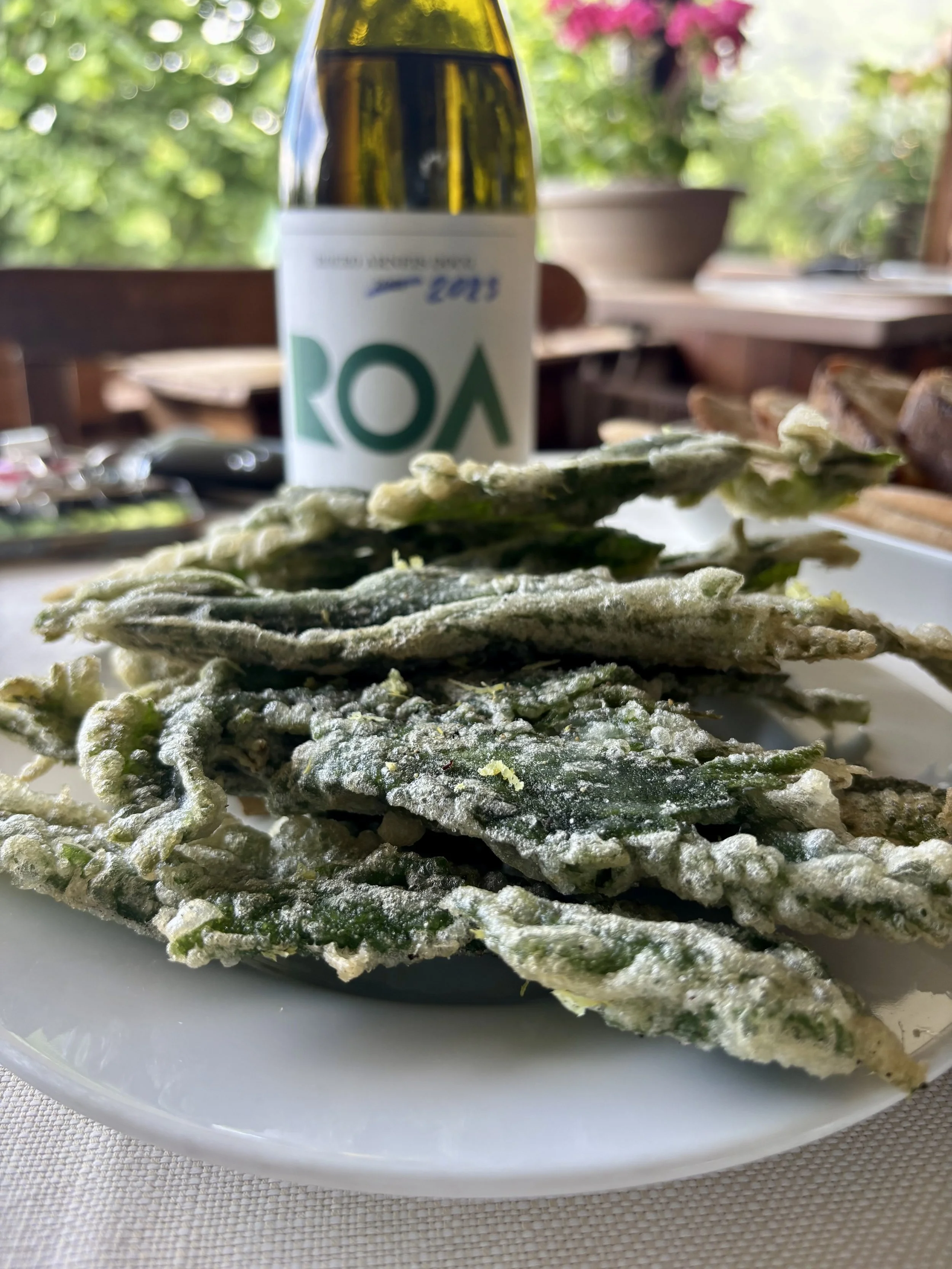
It still counts as a vegetable