Donkeys, Bread, and Cuddles: A visit to Carussin
I didn’t think we were going to meet. Matteo Garberoglio sent me a message in January. I was in the wrong part of Italy, too far away from San Marzano Oliveto. A week before I returned to Piemonte, I wrote him, asking to visit the farm. No response. I moved on. There’s always more places to go. I never complete the checklist.
A few days into my trip, Matteo responded. Matteo and Giorgia’s son was born prematurely. The couple had been in and out of hospital for a month, an all-consuming experience. Now little Edmondo is at home with the new parents. Still only 37 weeks. “He’s still minus three weeks old!” Matteo joked. The baby napped in a pram under mosquito netting while we tasted wines on the patio, in a space Matteo’s mother Bruna Ferro uses for her summer camp “Asinoi Pane Coccole” which translates to “Donkeys, Bread, and Cuddles.” It’s an 11-week program for 30 kids, 7am to 7pm each day. Matteo said there’s 30 minutes of homework each day, and lots of free play. Each week has a theme. An upcoming week they are talking about peace, using the symbol of olive trees, learning about people that embody the concept. They do a theatre show about each theme, and make a small book.
The camp isn’t new, but I feel its ambitions have expanded since my last visit. Bruna wanted to bring children from urban areas and show them animals and life in the countryside. It’s heart-warming to witness, and emblematic of the positivity underpinning the work of her family at Carussin. Geese, peacocks, and Piemonte’s oldest pig are among the cast of characters one meets during a visit to their multi-generational farmhouse and cellar. When I arrived, brothers Luca and Matteo Garberoglio were chilling under a 60-year-old mulberry tree. The region was once famous for silk production. Now the stand of mulberries bordering their driveway is protected.
We stepped into their cantina for a coffee and were immediately overwhelmed by the stench of a two-kilo durian that Luca hauled back from China. He’s considering making some durian panna cotta. The brothers share expansive travel duties, but work on the farm is strictly divided: Luca in the cellar, Matteo in the vineyards. The younger brother is excited to show off recent viticultural improvements, particularly the work of mycorrhizal mushrooms in their fields. Carussin used these funghi to resist drought in recent dry vintages like 2022 and 2023. In an average year, Piemonte receives 800-900mm of rainfall. Across 2022 and 2023, the area got 500mm total, between the two vintages. Adapting to drought conditions is vital.
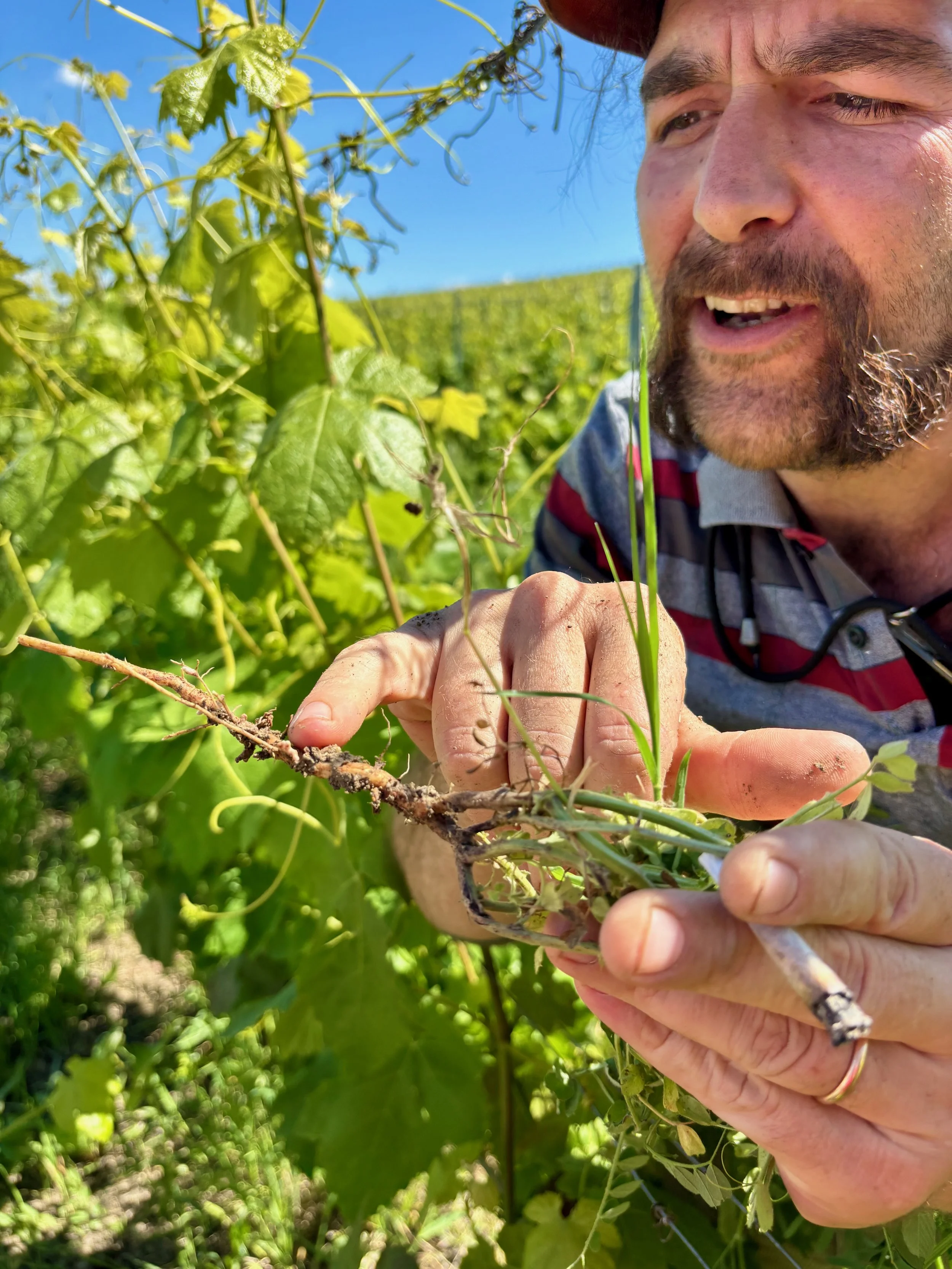
Matteo points out the mushrooms.
Mushrooms are responsible for bioregulation in nature. Carussin use seven different varieties of mycorrhizal mushrooms to take carbon from the plant, at the root. The mushrooms feed on it. “They are the link between life and death,” Matteo noted. The mushrooms speed the process of removing carbon produced by photosynthesis from the plant and transferring it into the soil. By returning all non-living things in the vineyard back into the earth, they feed the plant and aid the vines in their struggle to survive adverse weather conditions.
We walked through the Lia Vi vineyard. It’s the site closest to Carussin’s cellar. Since being replanted in 2017, the wine has been renamed “Cit Lia Vi” or little Lia Vi, to denote the utilisation of younger vines. Every other row in the field is seeded with a mix of beans and grains. Matteo trims them before flowering, to release the nitrogen that fixes to the roots of the beans back into the soil. In the dominantly clay soils of Lia Vi, these natural soil amendments are essential.
Walking through the Lia Vi vineyard on a sunny warm day, it’s possible to smell the vine flowers. I don’t think I’d ever smelled them before! It’s a very pretty aroma, akin to jasmine, but more delicate.
Matteo and Luca are avid readers. Matteo said he listens to books while doing the solitary pruning work that takes up so much of his life in the early months of the year. He begins every season with The Count of Monte Cristo, his favorite. “The book has everything! No writer has ever improved on it.” He’s also enthusiastic about the work of Alexander von Humboldt, an 18th century naturalist/philosopher who defined the concept of ecology. He delineated understanding of “the connectedness between all the characters playing the game,” as Matteo described it. Following von Humboldt’s lead, Garberoglio does annual analysis of the farm’s soil, insect populations, and the health and function of stems beneath the leaves that face vine clusters. In July, they pick 300 stems and send them to a lab for botanical analysis. The results give a snapshot of the function and healthfulness of the fields.
“A good farmer is a decent geologist.” Matteo said that he needs to understand the amount of iron and potassium plants on his farm will absorb after rainfall. As we walk down the hill, the soil visibly changes from primarily clay mid-slope, to more heavily schist at the bottom. Matteo noted that clay is a very nutritious soil for vines. “If I was born in the Mosel, with their rocky, steep vineyards, I would not have become a farmer!” In spite of swings between drought and wet, cold years, there’s a resiliency to viticulture in San Marzano Oliveto. The place is well-suited to growing grapes. Particularly with avid farmers like Garberoglio figuring it out, one year at a time.
In one recent experiment, Matteo left a section of new vineyard untended for five years, to give the plants time to focus solely on root growth. This year they are tending these plants, which seem to be in rude good health. In drought years Matteo avoids removing foliage. “Every leaf you pull creates a wound in the plant.” In normal years like 2026, he’ll remove leaves at 100 days of maturity. At that stage they have stopped photosynthetic activity. Stripping them away and leaving the younger leaves makes the plant more productive.
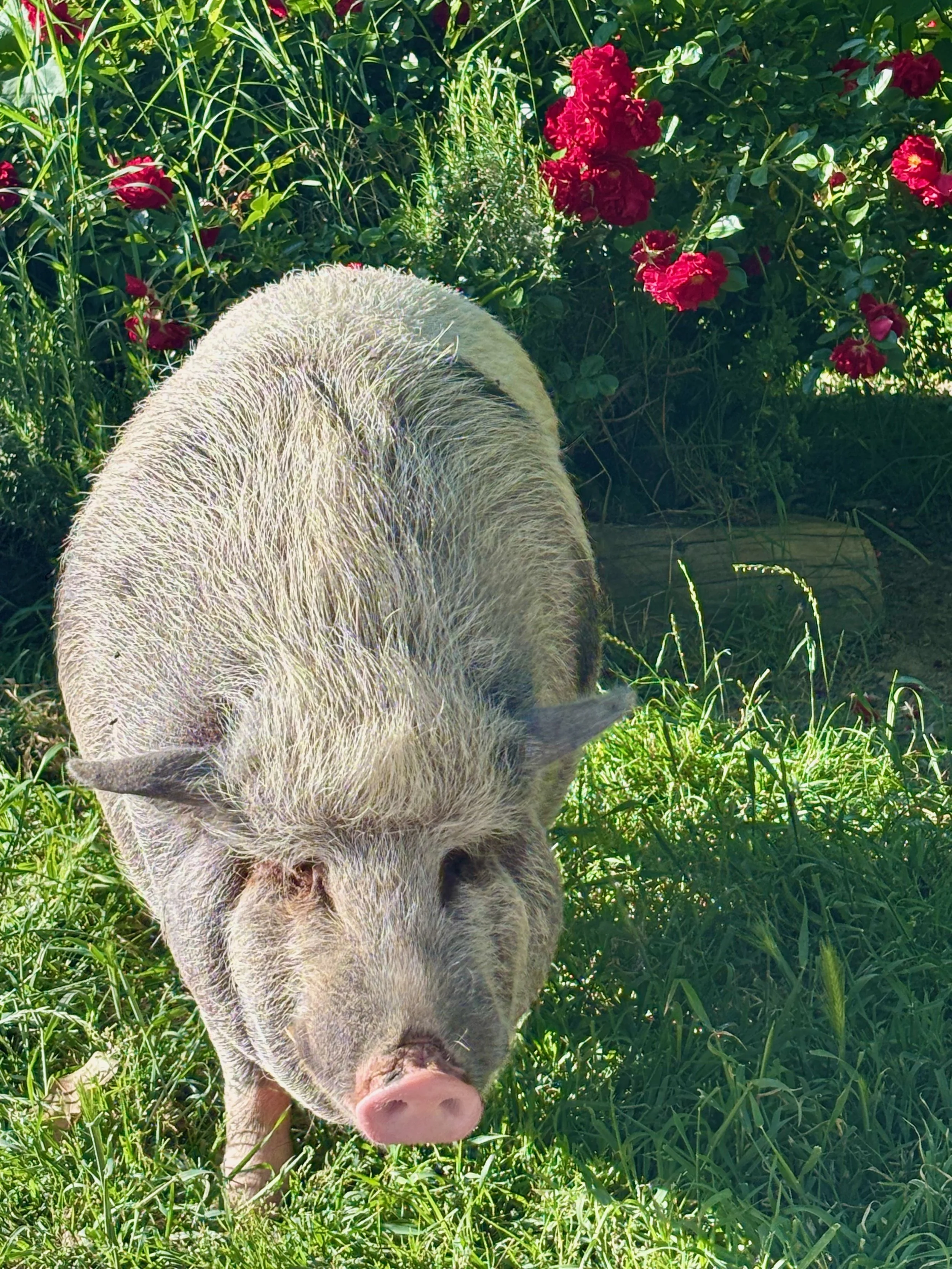
Piemonte’s oldest pig
“The problem with humans is we can’t stop at ‘it makes sense.’ We keep looking for answers and reasons, even when we find something that works. To understand properly, we need to look at the bigger picture of things.” We’ve circled back to discussing von Humboldt. We strolled over to a cherry tree practically bending to the ground with delicious ripe white and bright red berries. It’s at the boundary of a field Matteo is working, rows that belonged to a neighbor who recently passed away. The place stirs up happy memories of childhood for Matteo, who played in the field with the neighbor’s children decades ago. It’s full of reasonably healthy Moscato and Freisa vines, all organically farmed. Below it is a vineyard of compact dry earth and scant vegetation. A visibly sad field. Matteo wondered aloud why anyone would like to farm in such a way, to hurt the land and remove biodiversity. It seems obvious to me that people should want to buy food from regenerative agriculture instead of industrial commodity production, regardless of the quality (regenerative is almost always better.) Setting aside questions of taste, why support toxic production? Then again, why support Amazon? It’s hard not to step onto a soapbox. There are tens of millions of Americans struggling to survive on too-low wages, and those people need to eat with the resources they have at hand. But the American middle class, who can afford to find healthy food in their community, should do so. And the ruling class should care about sharing access to healthy food with the people their greed make sick.
Matteo never goes negative. Or rarely. I rail against Amazon. He talks about the WOOFer from Norway who stayed at their farm for a year, before buying a van to drive up and down the peninsula. Van life, Italian style. The man was from a community of reindeer herders in the northern extreme of Scandinavia. Each year his small family would catch, tag, and release into the wilderness hundreds of reindeer. Back at the patio, under a tree decorated with paper butterflies by kids from the summer camp, we talk about the diversity of the human experience. Luca, Giorgia, Bruna, and even Luigi (dad) made an appearance while we drank wine. Luigi’s cameo was brief. Newly bottled Asinoi needed to be delivered to a local bar. Luca and Matteo’s older children circled us on dirt bikes. Matteo’s daughter Iris brought us a bowl full of foraged mulberries, cherries, and edible flowers. “She’s going to be a wild one,” he said. “Ever since she was two years old, I’ve taken her out foraging for mushrooms with me.” Matteo has a safe mushroom foraging license, and knows the latin names of all the funghi he encounters in mountain forests from Asti to Savona.
Bottles continued to emerge from the cellar. Clan!Destino is Luca’s top fermented golden ale. They grow their own barley, and only use European hops. It’s a lovely beer, refreshingly lacking hop bitterness. As a person who has grown progressively more beer averse in recent times, this is a remarkably appealing ale.
Pink Completo 1-liter screwcap bottles exist! Finally: Matteo noted they made several failed attempts before this vintage, wines that were too dark, and tasted like carbonic Barbera. This one is reminiscent of tart cherry candy. Very floral, and perfect chilled to 12 degrees Celsius. Just over 11 percent abv. I like it.
2023 Tra Altro bianco is an enjoyable dry Moscato. This wine won’t make it to America, mostly because I struggle to sell dry Moscato. Which is a frustration, because it’s pretty tasty. Luca left it for six hours on the skins. He noted that Moscato has a high amount of sensitive terpenes. If you macerate it for too long you lose the character of the grape.
2024 Completo 1-liter screwcap rosso is very refreshing. It’s press wine, 80% Barbera, the remainder being “all the other grapes we grow.” Dolcetto, Nebbiolo, Ancellotta, etc. I prefer the 2024 to the 205, which is still quite refreshing, and good, but not quite as purely fruity.
2024 Cit Lia Vi Barbera d’Asti is also very nice. Luca noted that it’s a wine that can age. The wine always has more advanced color and texture than the farm’s other sites. Already some chocolate notes are coming out in this vintage.
2024 La Tranquilla Barbera d’Asti is back in production. The family did not produce it from 2019-2024. The wine is made from a specific chalky single vineyard below Matteo’s house, on a slope that faces the winery across a small valley. It’s very bloody. Luca bottled it from steel tank this vintage, no barrels used. We’ve never imported it.
We tasted the Carussin Dolcetto. Matteo noted that in the 1970’s Dolcetto was produced in the same volume as Barbera. Since then, most farmers in Langhe have replaced their Docletto with Nebbiolo, where possible. After a faint whiff of reduction the wine opens up to be very pleasant. I sell several really good Dolcettos from other farms. The market for this distinct grape is smaller than it should be.
Luca poured an unlabeled bottle with a crown cap. He described it as “Georgian style Nebbiolo.” Six months in clay amphora have mellowed Nebbiolo’s strong tannins. The wine is quite good. He’ll call it Nivola, an amalgam of the local name for rain (it was a wet year) and Nebbiolo.
2018 Sisto Nebbiolo smells good. There’s still some tannin on the finish. I’m excited to taste the 2012 bottle that I have stowed away in the NC warehouse.
Finally, we taste Carussin’s 2025 Moscato d’Asti. Very intense floral aromas. It’s really one of the best wines in a solid lineup. Luca described 2025 as being like a vintage from the 1990s. Not as cold as 2024. The wine is bottled with 125g/liter of residual sugar. I know there is a crisis in Moscato. This style of wine isn’t popular anymore. But that doesn’t change the fact that Luca and Matteo’s version is totally tasty.
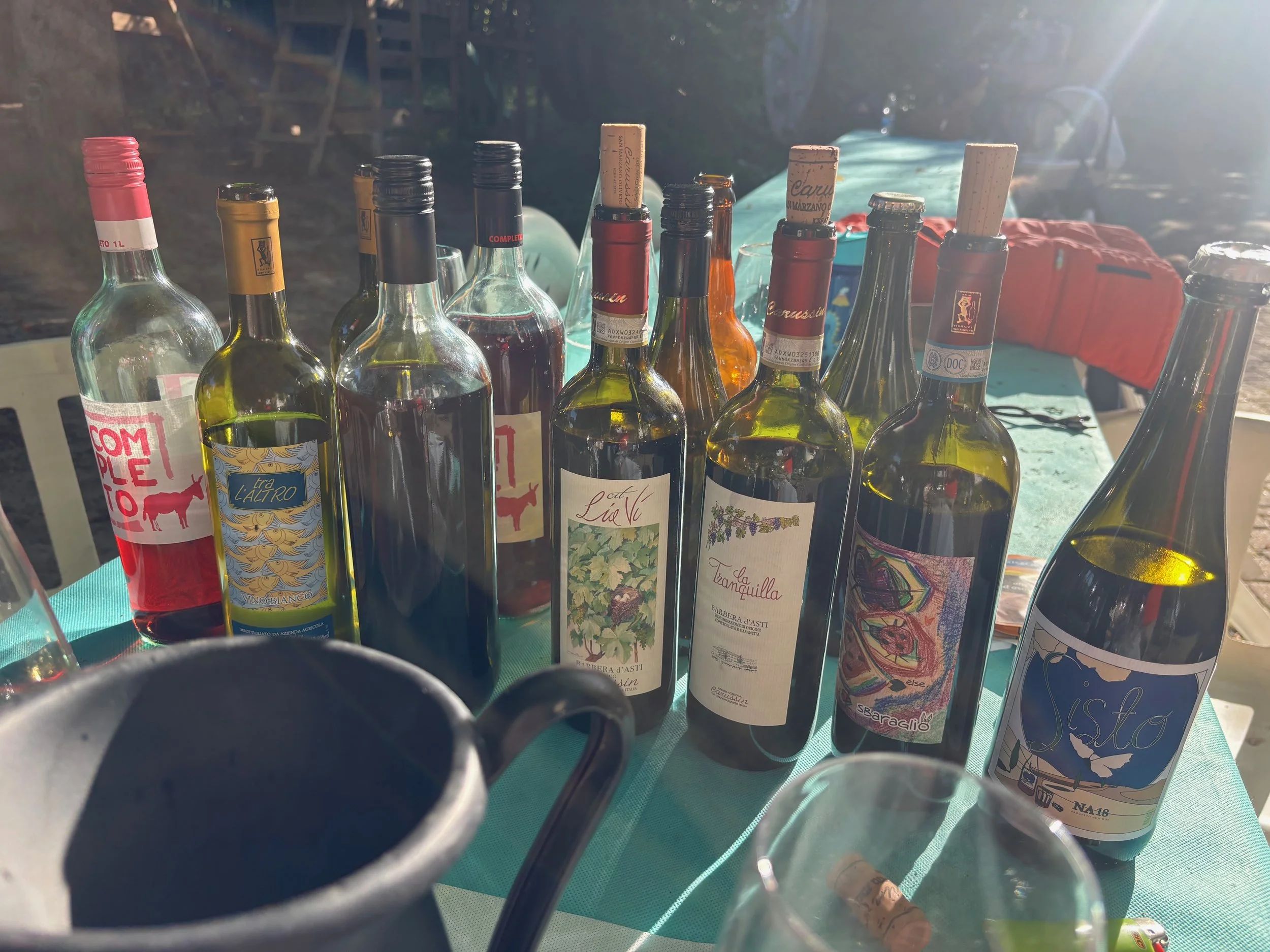
An afternoon tasting in the courtyard
It’s tough to say goodbye. It’s a place of sincerity. I’ve known them since 2012. I’ve stayed at Carussin many times. It’s a real farm, far from tourism, tethered to the reasons why I buy and sell wine. Walking through their menagerie on the path to the car, my mind skips through life lessons to be learned from this family. Embodying ceaseless positivity, Carussin stands in mute reproach to the dangerously unhealthy ways of living that permeate 21st century human existence. Or, they offer a template to a better life. It can be simple, if not easy. As Matteo said, “He who does not have the mind, uses the legs.” We can either think of a better way, or stay constantly running on life’s treadmill.