A Trip to Poggio di Bortolone (Vittoria, Sicily)
Poggio di Bortolone is close to the former American military base in Comiso. I’d stayed in the town before, maybe a decade back. It’s a part of the island where suitable accommodations can be had for moderate amounts of euros. Far enough from tourists hubs like Ragusa or Noto, but still in the thick of it all really. White haired men loiter in clumps on street corners, near cafes, in front of the cathedral. The local’s espresso bar is cash only, its proprietor generously adorned with neck tattoos. There’s the studio of a radio station, a wide piazza with palm trees and a statue of Diana and her hunting dogs, a short avenue of kebab stands and shops selling middle eastern wares. The vibe is working class. You can buy tile, appliances: normal things inhabit the center of Comiso. In 24 hours I saw a wedding, cathedral doors flung open to a massive baroque space overflowing with light and noise, and a funeral. The hill to the church (one of several downtown) is steep. Sturdy local men shouldered a casket along the long road leading to a side entrance. In the hot sun of an October morning I marveled at their bearing. Immaculate black suits, expressionless under a heavy burden.
Rituals bookended my time in Comiso. In between the union and the wake, I witnessed a festival honoring a famous sandwich. It was bigger than you are imagining. At center stage, surrounded by a throng of very animated senior citizens, a local couple kneaded dough, using a massive oar-like tool attached to a board, balanced on two chairs. It’s the traditional way to make bread for the Pane Cunzato. Over the crowd I could see the duo’s deft movements clearly, because in Comiso I am a giant. Every time the man pumping the oar pushed it down, I feared for the fingers of his agile counterpart, who was methodically rotating the dough ball. There was an element of danger and stagecraft to the proceedings. She emerged unscathed. Cheers and laughter ensued.
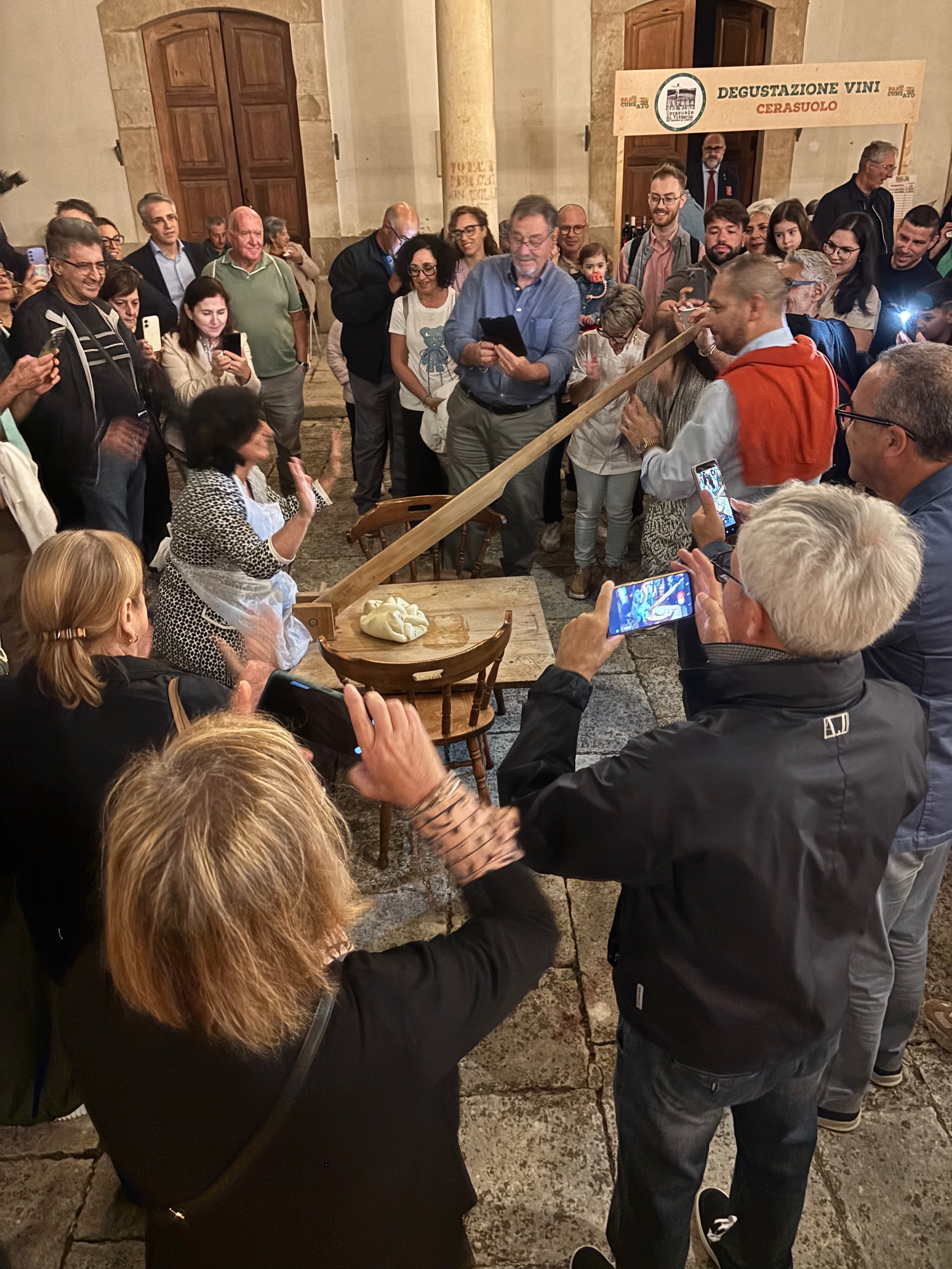
Pane Cunzato in progress
Stalls selling Pane Cunzato and other savory treats ringed a large stone courtyard. There was a tasting of Cerasuolo di Vittoria nearby, cannoli to be purchased, and so much more! Dancing horses, a falconer, tarantella dancing, a bouncy house for the tots, and a Coldplay cover band. I didn’t stay late enough to witness the final attraction. I did buy three jars of passata from a farmer. They cost five euros, total. And he threw in some free zucchini, and sun dried tomatoes. The pomodorini were delicious. The zucchini were eventually abandoned at a hotel. I didn’t have the heart to tell my generous contadino friend that I lacked access to a stove.
After several sandwiches and a night of deep sleep buffeted by the sound of drumming and revelry, I visited Pierluigi Cosenza at his farm. Poggio di Bortolone is 10km from the gulf of Ragusa, on a hill that rises from 220m to 280m above sea level. There are 15ha of vines on the property, and 30ha of mixed other crops: mostly wheat and olives. In mid-October, Pierluigi was about to begin the 2026 olive harvest. Tonda Iblea, Nocellara Messinese, and Nocellara Etnea. In spite of challenging weather conditions, he promised there will be oil for North Carolina. In 2026, Vittoria saw temperatures soar to 38 degrees Celsius (or higher) on 40 days. Even worse, the nights were still warm, rarely dipping below 28 degrees Celsius. Not what a grape desires. The 2026 wine harvest was early by any standards, spanning from August 24th to September 25th. I remain hopeful. Upon my arrival, Cosenza had just finished racking the new vintage of his standard-bearer Frappato off the skins. Too early to taste it, for sure. But Frappato will always by a wine that I’m eager to receive. Across the decade we’ve imported it, Pierluigi’s version has been consistently delicious.
Poggio di Bortolone was founded at the end of the 18th century. The property was sharecropped until 1970. As was common across much of southern Italy, workers were paid for their labor with a mix of cash plus one liter of wine per day. The original low ABV energy drink! Wine was safer than the local water supply in this historically malaria-prone southeastern corner of the island. Pierluigi’s grandfather estate bottling the farm’s wine in 1982. In the early years, he made two wines: a bottled/abeled version, and a high alcohol wine for blending that usually ended up bolstering some northern Italian estate’s anemic Barolo or Amarone. For a century at least, Sicily was the source of massive amounts of cutting wine for the north, and rarely (if ever) acknowledged as such. It’s a regional grievance.
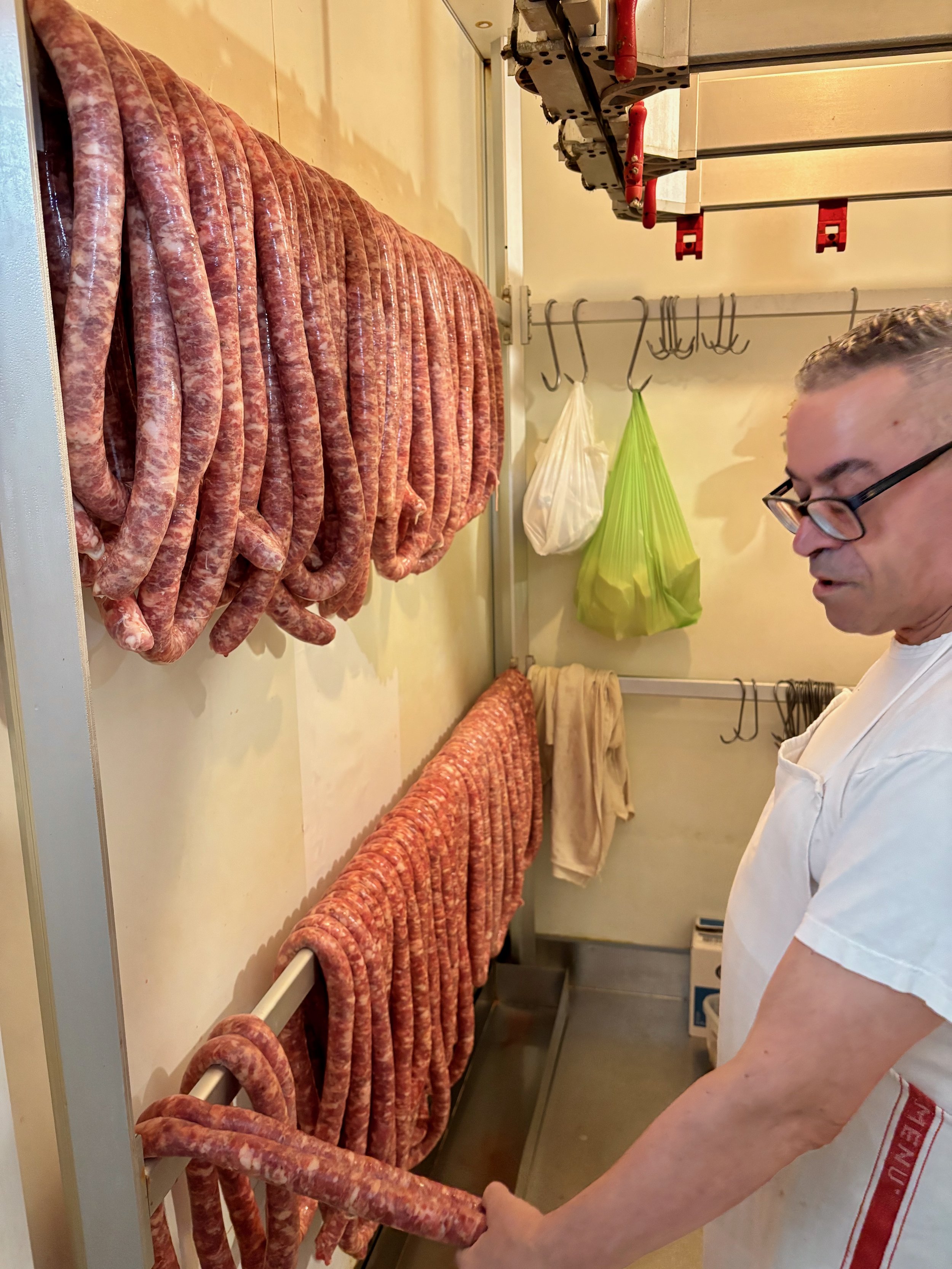
Sicilians take sausage seriously.
In 1980, there were five wineries inside the boundary of the Cerasuolo di Vittoria DOCG. Today there are 40. Pierluigi’s father was the only wine producer in their hamlet. Now Chiaramonte Gulfi has seven wineries. We move to the village’s iconic restaurant for lunch, and to taste the wines. Majore has been family-owned since the 19th century, making it one of the oldest continuously operated restaurants on the island. The restaurant is attached to a salumeria, which informs their pork-heavy menu. The testa is to die for: unctuous meat under a thick layer of aspic. I don’t think I’ve ever encountered tastier prosciutto/country ham. After lunch, we poked our heads inside the cold room of Majore, to ogle long salami links and hams. The qualitative distance between the cuisine of our two nations is never greater than in the realm of charcuterie. We simply do not have pork this good back home. Which is a small tragedy. Because we definitely have pigs.
Tasted at lunch, the 2025 Cerasuolo di Vittoria DOCG was a whirl of berry fruit aromas. Intense, unabashed, way more interesting than the (generally pretty high) standard for this DOCG. Aged in stainless steel, the wine contains slightly more Nero d’Avola than Frappato. I’d get ahead of the game and grab cases for Thanksgiving. Beaujolais is a played out recommendation if there ever was one.
The 2025 Frappato Vittoria DOC was delicate, with tart red fruit and a citrus edge. I can’t fully pin it down: flavors ping back-and-forth between pomegranate and Flintstones vitamins. Orange peel for sure, plus a slightly ferrous note. Frappato is easy, unabashed, fun. All fruit, no tannin.
As a seventh generation farmer, Pierluigi carries over two centuries of traditions into the modern era. It’s a heavy burden. His complaints are familiar. People who want to do agricultural labor are progressively more difficult to find. And few of the farmhands available have the specialized knowledge to work in a rigorous, quality-oriented way. But Pierluigi is a dynamic guy. Upbeat. I think he’ll find the path forward. The beauty of his homeland is striking. Global warming brought drought and extreme heat to Sicily. Conditions are unlikely to improve. Cosenza is adapting. He’s sending us fresher, cleaner, simply better wines than the challenging weather would yield if this farm had a less thoughtful steward. There’s a reason his birthplace was awarded Sicily’s first DOCG. Underpinning terroir in Vittoria makes creating world class wines a viable endeavor. I’ve never visited in summer, but in autumn Vittoria is a place I’d love to linger.
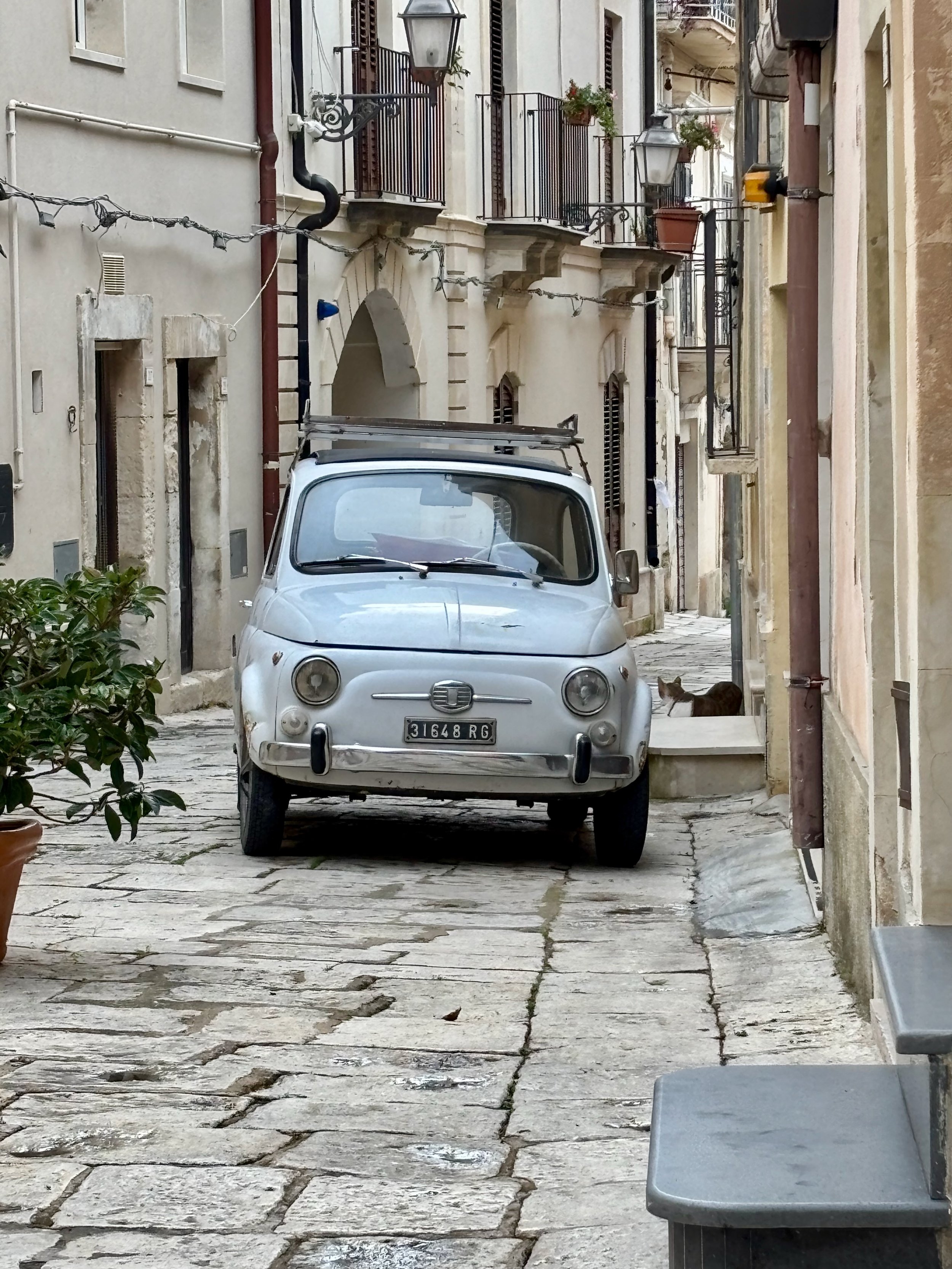
Chiaramonte Gulfi isn’t short on charm.